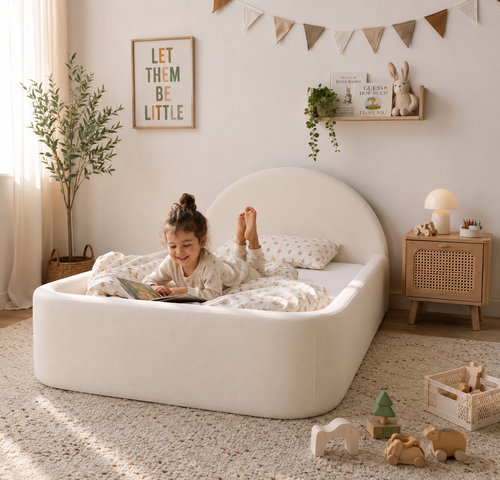
A Floor Bed vs Crib
Parents ask me some version of this question often: should my child sleep in a crib or on a floor bed?
I'm a family medicine physician, and I also founded a company that makes floor beds, so you should know where I'm coming from. I'll make the case for each option as honestly as I can, including where the crib is the better choice. The right answer depends mostly on your child's age and on how well you've prepared their room.
The short answer
- Under 12 months: Use a crib, bassinet, or play yard that meets current federal safety standards. This is the American Academy of Pediatrics (AAP) recommendation, and I agree with it.
- Toddlers (roughly 12 months and up, once ready): A floor bed is a reasonable option if the room is fully childproofed. A crib is also fine until your child starts climbing.
- Any age: The safest sleep setup is the one that fits your child's stage and that you can set up correctly every night.
Infants: the crib is the standard
For the first year of life, the AAP's safe sleep guidance is consistent: babies should sleep on their backs, on a firm, flat surface made for infant sleep, with nothing else in the sleep space. Room-sharing without bed-sharing is recommended, ideally for at least the first six months.
A crib or bassinet that meets federal standards is built for exactly this. It gives you a tested sleep surface, a defined sleep space, and containment while your baby cannot yet move around on their own.
If you are expecting a newborn, I would start with a crib or bassinet. A floor bed is not a substitute for that guidance. Talk with your pediatrician about any plan that departs from it.
Toddlers: where the picture changes
Around the time children begin to pull up, climb, and want independence, the trade-offs shift.
What a crib offers
- Containment. The child stays where you put them until you decide otherwise.
- A tested, standardized product with clear safety regulations.
- Familiarity, since many children are already used to it.
Where a crib gets harder
- Climbing. A child who can climb over the rail faces a fall from height. Lowering the mattress helps, and most families move on once a child can climb out, which is commonly cited as around 35 inches in height.
- Transition friction. Moving to a bed later means a second change at a stage when kids often resist change.
What a floor bed offers
- A very short distance to the ground, so falls are minimal.
- Freedom of movement. Your child can get in and out on their own, which is the core idea behind the Montessori approach to sleep.
- No separate crib-to-bed transition if you start with it at the right age.
- A low profile that works well in smaller rooms.
Where a floor bed takes more work
- The whole room becomes the sleep space. A child who can leave the bed can reach anything in the room, so the room has to be safe, not just the bed.
- Some children wander at night, play, or have trouble settling without a boundary.
- Airflow and moisture. A mattress sitting directly on the floor needs ventilation underneath, and should be checked regularly.
- Cooler air near the floor in colder months, which affects bedding and sleepwear choices.
What I'd check before using a floor bed
This is the list I'd go through as a physician before putting a toddler in a floor bed:
- Anchor all furniture to the wall: dressers, bookcases, anything that can tip.
- Cover outlets and secure or remove cords, including blind and curtain cords.
- Secure windows and keep the bed away from them.
- Use a gate or door cover if you want to keep your child in the room or out of the rest of the house overnight.
- Remove small objects, sharp edges, and anything top-heavy within reach.
- Keep the sleep surface simple. Even for toddlers, fewer soft items is the better default.
- Check the materials. Look for mattresses and foam with third-party certifications, and check the cover and any finishes.
- Keep the bed away from heaters, radiators, and vents.
- Get on your child's level. Sit on the floor of the room and look for anything you'd otherwise miss.
If you can't complete this list, a crib may be the better choice for now.
How to decide
A few practical questions help:
- How old is your child? Under one year, choose a crib, bassinet, or play yard.
- Is your child climbing out of the crib, or close to it? If so, it is time to move on from the crib, and a floor bed or toddler bed are both worth considering.
- Can you fully childproof the room? If yes, a floor bed is an option. If not, wait.
- How does your child sleep? Some children do well with freedom, and others do better with clear limits. You know your child best.
- What can you set up consistently? A simple setup you maintain beats a perfect one you don't.
My honest take
I don't think floor beds are better than cribs, and I don't think cribs are better than floor beds. They are suited to different stages. For infants, the crib is the right tool. For many toddlers, a floor bed works well and supports their growing independence, as long as the room is properly prepared.
If you're deciding between the two, start with your child's age, the room, and your own routine, not with trends. And bring your questions to your child's pediatrician, who knows your child's health and development.
This article is for general information and is not medical advice for your child. Always follow the AAP's current safe sleep recommendations and consult your pediatrician about your child's sleep.